
Probably Stolen Water Merchant: How the Water Business Pays
The Water Merchant start hands you a water testing and purification kit. Here is the water business loop, the upgrade order and the three traps that cost money.

In Probably Stolen, the water trade is the lowest-barrier steady income line in the game: no rare goods, no luck — just a loop of sourcing, purifying and selling by tier. What actually decides your income is not volume.
It is who you can sell to, and whether you treat filters as a consumable or as an asset.
First, separate the two things the developer said
These get mixed up constantly, and they are not the same:
- The starting scenario. The August 28, 2026 announcement added a new demo starting scenario, The Water Merchant. The demo store page lists “3 starting scenarios + hardcore mode” and states plainly that a water testing and purification kit is available from the start in the Water Merchant scenario.
- The water upgrades. Back on August 6 the developer already shipped the Water trading guide, purchasable from Dr. Jackson, plus three Wild Network water upgrades: Retired Water Merchant, Gutterflow on Tap and Rustwater on Tap — and the same patch note says explicitly that these are “not the Water Trade starting scenario”.
So: changing your starting scenario changes your opening kit; the Wild Network entries are mid-run purchases. The developer has not published numbers or prices for those three upgrades. So treat any “this one always pays X” claim as unverified.
A loop you can actually repeat
- Source the liquid. Water comes from scavenging, walk-in customers and suppliers, or straight from the tap as Rustwater. Early on. Buying cheap and topping up by scavenging is the easy version.
- Purify it. In player testing the working path is to test and treat the water. Then run it through the pitcher and filter. Filters have durability. So running a nearly dead filter through a large batch is wasted work.
- Set the tier. The game grades water, and higher tiers are harder to make and pickier about buyers. The full rules on grades. Tools and labels live on the water page; this page stays on the business side.
- Sell to the right buyer. The September 14 patch is blunt about it: Premium Spring Water only sells to Upper Level customers — ordinary customers and tourists refuse it. Being able to make it does not mean being able to sell it.
Staged plan: run volume, then bait buyers, then buy machines
Early (cash flow). Make only the tier you can move reliably and keep the loop spinning. The goal is water in the display case every day. Not one perfect barrel on a lucky day.
Mid (attract buyers). Upper Level customers look at what you display. The common player approach is to put water in large-capacity containers on the display case so that water as a category reaches high-budget customers. In the Chinese community this step is treated as paying off sooner than stacking equipment.
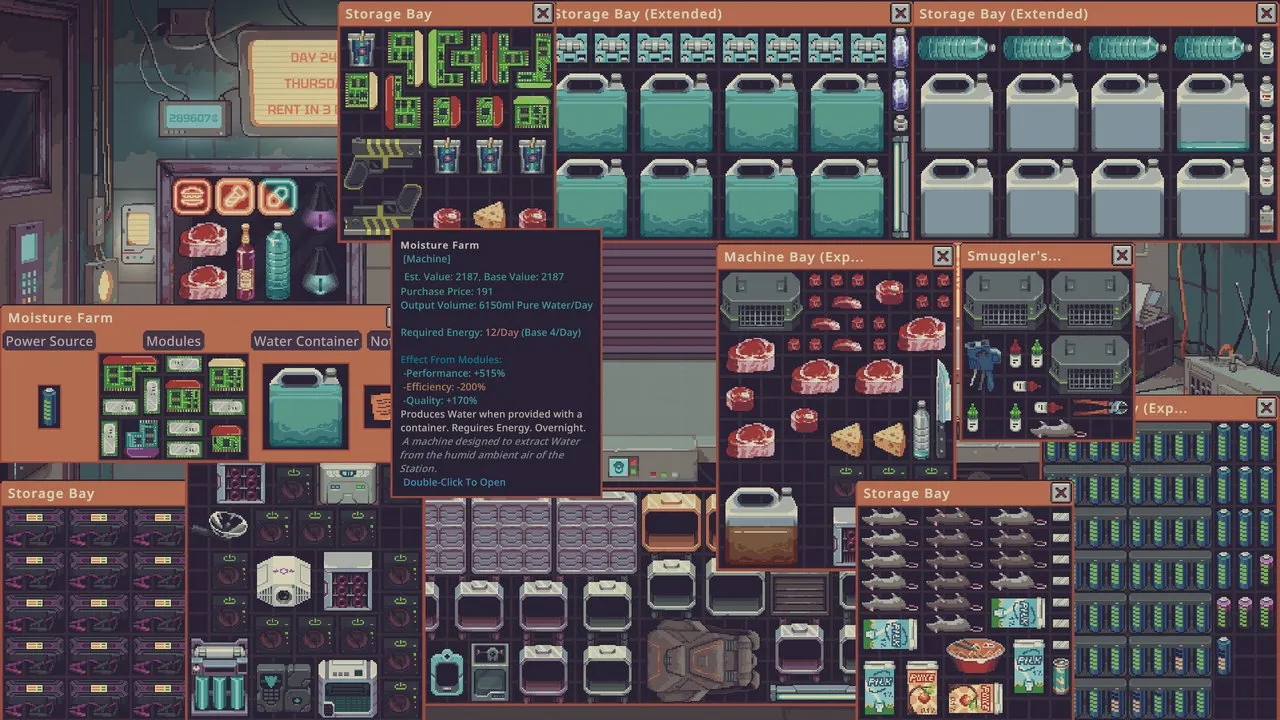
Late (scale). An official store screenshot shows a machine that extracts water from the ambient air of the station. Its tooltip reads:
- Output 6150ml Pure Water/Day
- Required Energy 12/Day (base 4/Day)
- Module effects: Performance +515% / Efficiency −200% / Quality +170%
- Requirements: needs a container, needs power, runs overnight
Note that those figures are the module-modified display, not the bare machine. Player consensus ranks module priorities as Performance > Quality > Efficiency. And many argue for buying this extractor before a purifier — solve “do I have water” before “is my water good enough”.
The two things people forget: filters and containers
Do not bin dead filters. Player testing found that three filters at zero durability can be refurbished into one fresh filter at the underground exchange. Player testing also reports advanced filters appearing in Dr. Jackson’s rotating stock and in crates. Run that loop and filters stop being pure expense. (Read the underground exchange page first — the exchange itself is only partly documented.)
An empty container is not water goods. The September 14 patch changed the rule:
- a water container counts as water goods while it holds liquid and as household goods when empty
- market events reprice the liquid and the container separately
- and the pitcher now counts as a household item too. Check the container state before you sell
- or you will price a full jug as furniture.
Three traps
One: the missing starting kit (fixed). On demo launch day both the English and Chinese forums filled with “the water trading start gave me nothing”; the developer hot-fixed it the same day.
If your bag is empty at the start today, check you are on the current build before assuming you missed the kit.
Two: do not fake the label. Chinese guides circulate a trick — label high quality water as pure water to bait Upper Level water buyers. But the September 14 patch fixed customers confronting the player over a wrong water quality label: a wrong label gets caught and costs reputation. We do not recommend it. Matching label and contents is the durable play.
Three: price the electricity before the machine. The extractor needs power, a container and the night to run. Sort out power and supporting hardware before adding machines. Or you will own a machine you cannot afford to run.
What the developer has not published
- The numbers, prices and returns of the three Wild Network water upgrades;
- A complete water tier table, per-tier prices, or any concentration-to-price formula;
- The filter refurbishment rate, the bare machine’s output, or module return on investment.
Every “how many millilitres”, “what percentage” or “how many days” figure above that comes from player testing or Chinese guides is labelled as such, and most of it was measured on the August playtest build.
The demo changed purification precision, filtering behaviour and container pricing, so treat your own build as the source of truth.
Once the water line is running, the natural next step is winemaking — it consumes exactly the liquid and containers you are already handling.
Related Articles
guide
Probably Stolen Rat Farming: Trap, Feed, Breed, Butcher
Live rats have almost no buyers; the money is in the meat. Trap them, house them, tune them with serums, and butcher them with a blade.
guide
Probably Stolen Water: Test It, Filter It, Sell It
Water sells by grade, not by the jug. Test it, filter it, relabel it, then sell each grade to the customers who accept it.
guide
Probably Stolen Winemaking: The Recipe and What Sets the Tier
The in-game fermenting guide is short: 1-2 berries, 750 ml of liquid, optional yeast and time. Three levers decide the bottle tier.